How to Study Poker in 2026 to Beat Everyone

The way poker players study has evolved dramatically. In 2026, the gap between those who use modern study methods and those who rely on intuition and experience alone is bigger than ever. This guide covers exactly how to study poker in 2026 to gain a genuine edge over your competition.
The 2026 Poker Study Framework
Modern poker study follows a clear hierarchy:
- Solver work – Building unexploitable baseline strategies
- Database review – Identifying leaks in your actual play
- Spot-specific drilling – Mastering high-frequency situations
- Live study – Table observation and player profiling
- Mental game – Managing tilt and decision-making under pressure
Step 1: Solver-Based Study (GTO Foundation)
Which Solvers to Use in 2026
| Solver | Best For | Price | Difficulty |
|---|---|---|---|
| PioSOLVER | Postflop deep analysis | $249-$999 | Advanced |
| GTO+ | Quick solving, tournaments | $33/mo | Intermediate |
| SimplePostflop | Cloud-based, mobile | $20/mo | Intermediate |
| GTO Wizard | Pre-built solutions, drilling | $39-$79/mo | All levels |
How to Use Solvers Effectively
- Focus on high-frequency spots: SRP IP vs OOP c-bet situations, 3-bet pots
- Study range nodes, not just individual hands: Understand why entire ranges bet or check
- Practice by drilling: GTO Wizard and Poker Trainer allow hand-for-hand drilling
- Build a study library: Save solved spots for later review sessions
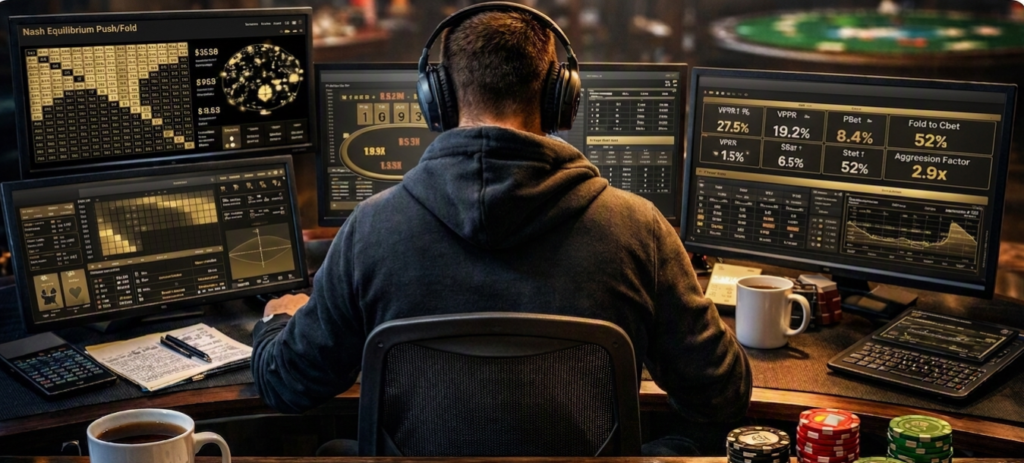
Step 2: Database Analysis (HUD Work)
If you play online, database software is non-negotiable in 2026.
| Software | Platform | Price |
|---|---|---|
| PokerTracker 4 | PC/Mac | $99 one-time |
| Hold’em Manager 3 | PC | $99 one-time |
| DriveHUD 2 | PC | $99 one-time |
Key Stats to Review
- VPIP/PFR: Are you playing too loose or tight preflop?
- 3bet%: Identify if you are under- or over-3betting
- Fold to C-bet: Are you folding too much to c-bets on certain boards?
- Turn and River aggression: Are you continuing bets appropriately?
Step 3: Effective Study Routines
The 3-2-1 Weekly Study Plan
- 3 hours: Solver work (new spots or drilling existing solutions)
- 2 hours: Database review (review last session’s hands)
- 1 hour: Video study (training site or YouTube analysis)
The Spot Isolation Method
Instead of studying randomly, pick ONE spot per week and go deep:
- Identify a spot where you feel uncomfortable or unsure
- Solve it in a solver for the most common board textures
- Drill 200+ hands in that exact spot using a trainer
- Play it live with awareness, review those hands after
Step 4: Training Sites in 2026
- GTO Lab: Best for solver-based courses. See our full review
- Run It Once: Wide variety of coaches, philosophy-based learning
- Upswing Poker: Best for beginners, structured curricula
- Solve for Why: Tournament-focused, excellent MTT content
- The Poker Lab: ICM and tournament specialists
Step 5: Mental Game and Tilt Management
You can have the best strategy in the world and still lose if your mental game is broken. Key principles:
- Accept variance: Even the best players have 50+ buy-in downswings
- Session review ritual: End every session with a 15-minute review before sleeping
- Stop-loss rules: Set a clear number of buy-ins where you stop for the day
- Read The Mental Game of Poker by Jared Tendler – still the definitive text
Practice What You Learn
The best study is useless without application. Start applying your new skills in low-risk environments:
- Free play on poker apps
- Our exclusive Stake Poker freerolls – real tournament experience, zero risk
- Micro-stakes cash games (start at NL2 or NL5)
Check our best poker sites guide to find the right platform for your level.